



You open Google Analytics on your phone and the numbers hit you hard: over half your visitors are on mobile, yet most of them vanish in under ten seconds. They never see your services, never read your story, never pick up the phone to call. If you’ve ever searched “mobile users leaving my website,” you already feel the frustration. Your desktop version looks perfect, but on a real phone it feels slow, clunky, and impossible to use. This isn’t just a small glitch—it’s a silent business killer. At Humbletechx we build fast, mobile-first websites for small businesses exactly like yours. We make sure every visitor, on every device, gets the confident handshake your honest work deserves. Today you’ll discover exactly why mobile users are abandoning your site and the ridiculously simple 3-minute fix that can stop the bleed immediately.
The 3 Mobile Sins That Cost You Customers Every Day
Three common but invisible mistakes are driving mobile abandonment every single day, and most business owners never spot them until it’s too late.
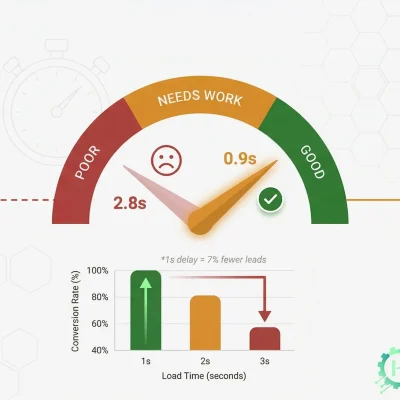
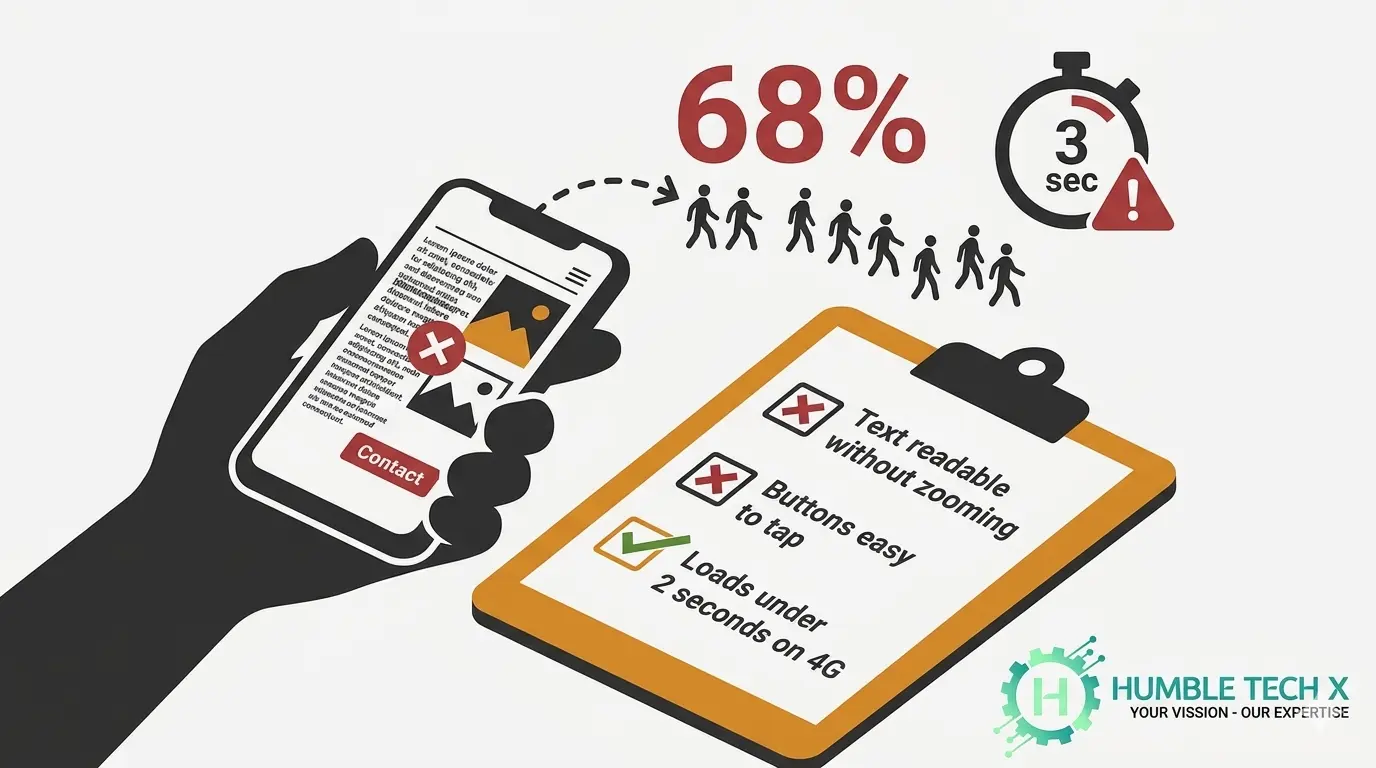
First, pages that take forever to load on 4G or slower networks. Your potential customer is sitting in traffic, on a bus, or waiting at a shop, and your site is still spinning. Every extra second feels like forever.
Second, buttons and menus placed where a thumb simply can’t reach without awkward stretching or two-handed juggling. On a phone, people use one thumb (80% of the time). If your “Call Now” button sits at the very top of the screen, it might as well be invisible.
Third, text so tiny or cramped that visitors have to pinch and zoom just to read a single sentence. They came for quick answers, not an eye exam.
Here’s the mobile abandonment calculator that makes the damage crystal clear: If 100 mobile visitors land on your site and 50 leave because it’s slow or broken, and each lead is worth $50, that’s $2,500 lost per month. Over a year? $30,000. That money is disappearing right now while you read this on your laptop.
These sins aren’t flashy design errors. They’re quiet, everyday frustrations that add up to lost revenue for local plumbers, electricians, cafes, and consultants across Pakistan. The worst part? You probably don’t even notice them because you always check your site on fast Wi-Fi at the office.
The ‘Thumb Test’ – Do It Right Now
Take out your actual phone—the one your customers use. Open your website in a normal browser window (turn off desktop mode). Hold the phone exactly the way a real customer would: one hand, thumb ready to scroll and tap.
This is the Thumb Test—a 3-minute self-audit that requires zero technical skills and reveals more than any analytics dashboard ever could.
Step 1: Scroll naturally with your thumb. Can you reach the top menu, the phone number, and the main call-to-action button without readjusting your grip or switching hands? Most sites fail here immediately.
Step 2: Focus on the bottom third of the screen. That’s the thumb zone—a curved, fan-shaped area that starts at the lower left and right corners and arcs upward comfortably about two-thirds of the way up the screen. Imagine drawing a smooth green rainbow on your phone: everything important (your contact button, navigation, “Get a Quote” form) must live inside that easy-reach arc. If your most important button sits outside it, customers are literally stretching to do business with you.
Step 3: Try tapping everything once. If you miss twice, have to zoom in, or feel any frustration at all, your site is costing you sales right now.
Run this test in the next 60 seconds. Nine out of ten small-business sites fail on the first try. The beautiful part is that fixing it is simple once you see the problem with your own thumb. No coding, no expensive redesigns—just smart placement that respects how humans actually hold their phones.
Why Fast Loading on Desktop Means Nothing on 4G
Here’s the truth most business owners miss: your desktop site loading in under two seconds means absolutely nothing for mobile users. On 4G networks common in Islamabad, Rawalpindi, Lahore, and smaller cities, large hero images, heavy sliders, unoptimized scripts, and extra tracking tools add up fast. What feels instant on office Wi-Fi becomes a painful wait on a phone.
Google’s own studies show that 53% of mobile visitors abandon a site that takes longer than three seconds to load. Every extra second after that kills another chunk of conversions. Desktop speed tricks like caching don’t solve the mobile reality of smaller screens, slower connections, and data limits. Your customer isn’t patient—they’re already scrolling Google for the next option.
The fix is surprisingly straightforward: compress images properly for mobile, remove unnecessary animations, and prioritize content that loads first. When your site respects real mobile conditions instead of pretending everyone is on fiber internet, bounce rates drop and enquiries rise.
A Local Business That Doubled Mobile Enquiries Overnight
Last month we ran this exact audit with a plumbing company in Islamabad. Their old website looked clean on a laptop but forced mobile visitors to hunt for the phone number, pinch-zoom tiny text, and wait while large photos loaded. Customers told us later they gave up and called the next plumber on Google instead.
We applied the Thumb Test, moved every important button into the thumb zone, compressed images for lightning-fast 4G loading, and simplified the layout so nothing required zooming. The entire change took one weekend. No complicated tech, just mobile-first thinking.
The results were immediate. Mobile enquiries doubled within the first week. The owner called us excited: “Customers are now calling straight from the site instead of bouncing back to search. I can’t believe how much business we were losing without realizing it.”
Your business can see the same overnight turnaround. The difference between a site that loses mobile customers and one that wins them is smaller than you think—just smarter design that works where your customers actually are: on their phones.
Run the thumb test on your site right now. Frustrated? Let’s fix it in a weekend. Free mobile audit → humbletechx.com